

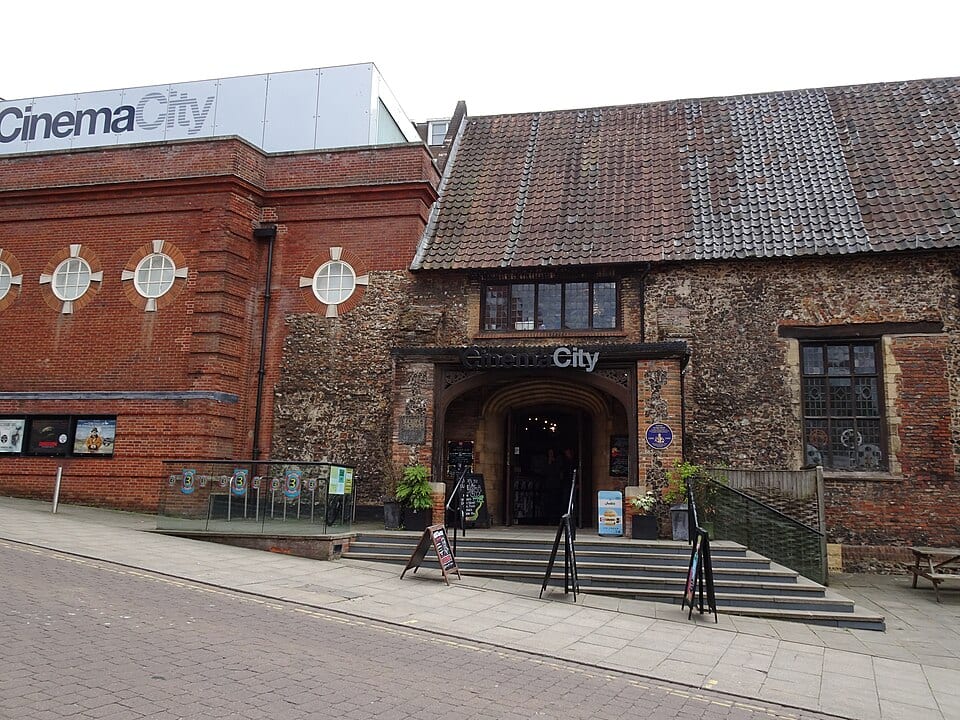
Cinema City, June 2026. Photo: Spudgun67 / Wikimedia Commons (CC0). |
Going to the cinema is usually about looking forward to the film. We choose a screening, meet friends, find our seats and settle down as the lights dim. In Norwich, however, a visit to Cinema City also offers something worth considering before the opening credits: the building itself. On St Andrews Street, the cinema occupies a remarkable group of historic buildings centred on Suckling House and Stuart Hall. Its story spans centuries and includes merchants, civic generosity, education and the changing ways in which Norwich residents have enjoyed their leisure time. A house from another NorwichSuckling House takes its name from the Suckling family. The cinema’s own account of the building’s history connects it with Robert Suckling, who served as mayor and sheriff of Norwich. To imagine the setting of a medieval merchant’s home, we have to look beyond today’s traffic, shopfronts and cinema listings. Norwich was a prosperous trading city, and substantial houses reflected the importance of merchants within it. Historic England describes the property as a former hall house with later alterations and additions. Its Grade I listing records elements of flint, brick and stone, as well as the significance of the surviving historic fabric. The building is not the product of one moment: different generations have adapted it to different needs. Accounts differ in their dating of the earliest surviving parts, so it is safer to describe the house as medieval than to give the entire structure a single precise year. The listing itself makes clear how much the property has evolved. That layering is part of what makes buildings like this so interesting. You can find traces of the Norwich of long ago in the same complex where people now come to watch a newly released film. A gift for the cityThe next major chapter brings two members of a family especially familiar to Norwich residents into the story. According to Cinema City’s account, Ethel Mary and Helen Caroline Colman bought Suckling House in 1923. They added Stuart Hall and gave the property to the city in 1925 for educational purposes. The Duke of York formally opened it to the public. Historic England identifies the architect Boardman in connection with the substantial 1925 addition. What had once been a private house was taking on a different civic role, providing a place for members of the public to gather and learn. It is an important episode because it helps explain why this particular historic property is still part of everyday life rather than simply a landmark viewed from the pavement. Its transition into public use laid the foundations for another transformation later in the century. |
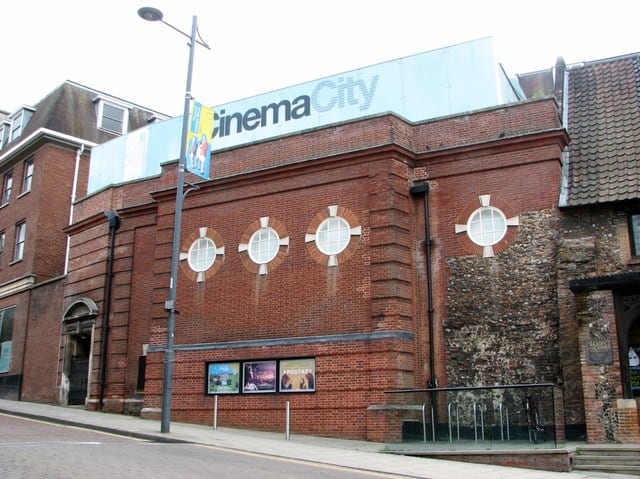 |
St Andrews Street — Cinema City (2018) © Evelyn Simak / Geograph. CC BY-SA 2.0. |
The arrival of the cinemaCinema City opened in April 1978, according to the venue’s own history. The idea of bringing films to this setting gave Norwich a new way to use a building already associated with public education and gathering. The cinema underwent redevelopment between 2004 and 2007, with additional screening space created. Today the venue has three screens, alongside its courtyard and bar facilities. Bringing modern cinema facilities into a historic building is a very different proposition from starting with an empty site. The result is a venue with a sense of place that is difficult to separate from the streets around it. The building’s history also reflects a broader truth about cultural spaces. They rarely remain static. Audiences change, technologies develop and communities find new ways to use familiar places. The challenge is to adapt while recognising the value of what has gone before. Looking at the familiar with fresh eyesOne of the pleasures of spending time in Norwich is discovering that a place you already know has another story behind it. Cinema City is particularly rewarding in this respect because you do not need to set out on a heritage tour to encounter that history. A trip to the pictures is enough of a reason to go. The venue’s Cinema City information page provides details of its facilities and history, while current screenings, ticket prices and access arrangements can be checked directly with the cinema before a visit. Whether you are a regular visitor or have not been for years, the building offers a reminder that cultural life in Norwich has often found a home within the fabric of the older city. When the lights go down, the film may take us anywhere in the world. When they come back on, we are still in a place with a fascinating story of its own. |




0 Comments
Join the conversation
Be the first to comment
Share your thoughts above.