

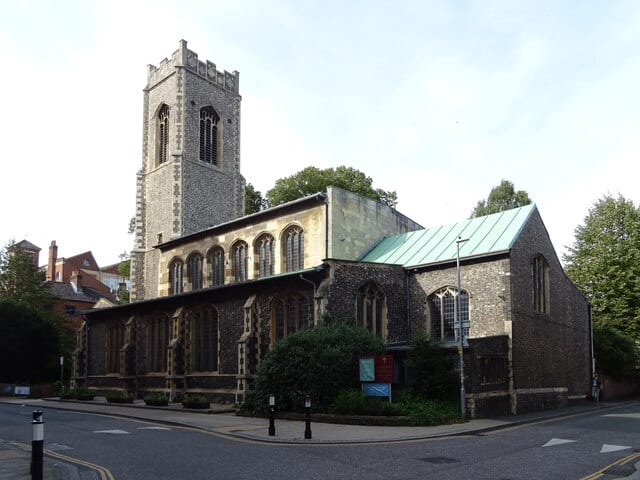
The Church of St George, Colegate (archive, 2023; resized). © JThomas / Geograph, CC BY-SA 2.0. |
A few planters in the city centre can be easy to overlook. They might look like a modest way to brighten a space or grow a handful of vegetables. For Norwich's Big Grow project, though, the starting point was also an invitation to think about who gets to take part in growing food, and where that can happen. The project, run through the Big Issue, trialled community food growing at three Norwich sites in 2025. An account published by its team in October 2026 describes work at a church in Colegate, St Giles' Church and the New Routes charity shop. The following development was not simply another planter: the project began working with students at a nearby school. The move from street-level growing to a school elective is worth exploring because it brings the practical work of planting, tending and harvesting into a different setting. It also demands some care about what has happened already and what remains an ambition. Three places to beginThe Big Issue's account by Parveen Bird, published on 6 October, looks back at three city-centre trials in the previous year. It identifies Colegate Church, St Giles' Church and New Routes as sites where the project explored food growing with local communities. According to that account, harvests differed across the locations. The organisation says it saw people engaging with the process, but this is its own description rather than an independently measured assessment of outcomes or participation. Food growing in small urban spaces has obvious limitations. Space, weather, attention and access to equipment all matter, and a small plot cannot be expected to supply an entire neighbourhood. The point of a community project may instead lie in making the steps visible and giving people somewhere to learn and contribute, even when the amount grown is modest. The Big Issue's original project announcement in April 2025 presented the Norwich trial as a way to bring people together around growing skills. That is useful historical context, but a launch ambition is not evidence that every proposed outcome was achieved. The later report is the stronger source for what the organisation says actually followed. Across the road into school learningIn 2026, the Big Grow team described beginning a food-growing project with pupils at Jane Austen College, on Colegate. The school's identity and address are confirmed by Norfolk County Council's school directory. The Big Issue's account calls it Jane Austen School, while the official institution name is Jane Austen College. |
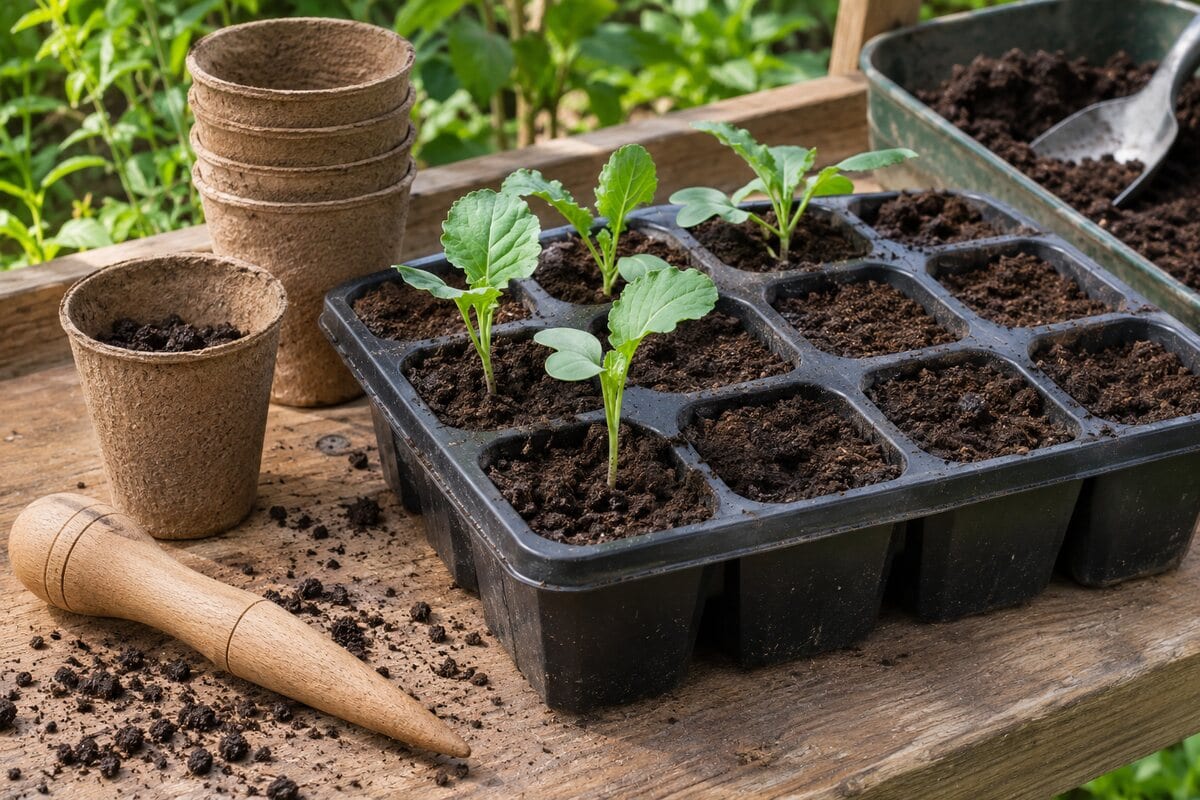 Illustration: vegetable seedlings and seed-sowing materials. |
A pupil's idea for a rooftop garden was part of the story told by the organisation. That should not be confused with proof that a rooftop garden has been built, opened or planted. The published account describes a vision and then a year-long growing elective, two different stages of a developing project. The organisation credits Claire Honess with supporting the idea and says Bupa Foundation Green Community Grants helped fund the elective. Those details give the development a recognisable local shape: a plan discussed in the school setting, support from staff and a funding route that made structured learning possible. The published description of the elective includes learning about growing and harvesting, seasonal food, water conservation, biodiversity and ways produce can be preserved or stored. Those are planned areas of learning, not results from a completed course. The account does not establish how many pupils have finished it, how much food has been harvested or what longer-term effects it may have. Why the practical detail mattersThere is a difference between explaining food growing in a lesson and giving young people an opportunity to take part in it. A seed has to be planted at the right moment, watered and watched; the eventual harvest depends on things that no worksheet can guarantee. |
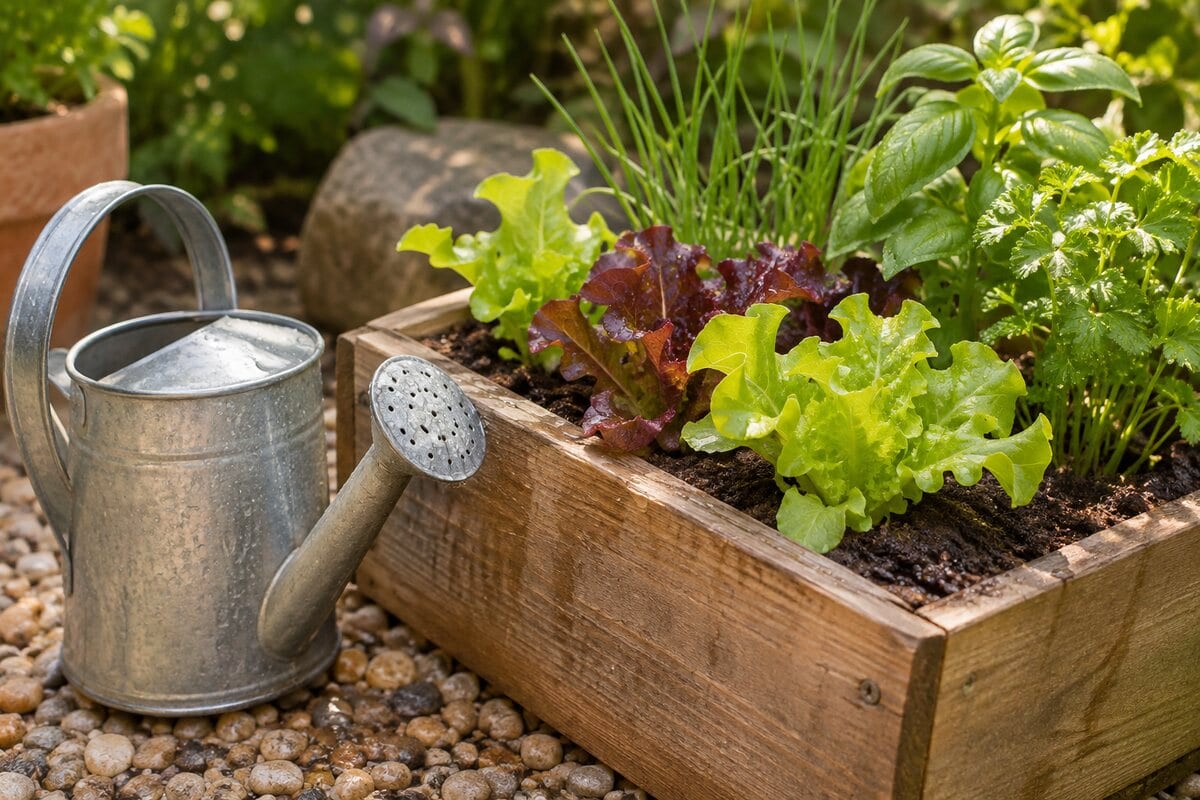 Illustration: tending salad leaves and herbs in a small planter. |
The Big Grow account frames this hands-on element as important to the programme. For Norwich readers, the connection with Colegate also matters. The school and one of the original sites are close to each other, so the idea has crossed from a community space into an education setting without moving the story out of the city. But it would be misleading to build a colourful scene around named pupils, quote them without permission or claim personal improvements in health, confidence or achievement. That would require interviews, consent and independently supported evidence. The account as it stands is best understood as a reported example of an organisation extending its work into education. Nor is it a public invitation to visit a school growing area. There are no verified drop-in sessions or volunteer recruitment arrangements attached to this particular school project. Anyone interested in getting involved should use official contact routes and ask about current opportunities rather than assuming a site is open to visitors. What the next chapter could showThe most interesting unanswered questions are practical ones. What growing space is currently in use? How have lessons been organised as the seasons change? Which parts of the original city-centre experiment proved useful when the project entered the curriculum? Those are questions for the people doing the work, not blanks to fill with assumptions. For now, the verified story is a modest but meaningful progression. Big Grow began with several Norwich community-growing trials, and its organisers now describe a funded school elective linked to that earlier work. It is a story about trying to make food growing part of local learning, while leaving room for the facts about its results to emerge in time. |




0 Comments
Join the conversation
Be the first to comment
Share your thoughts above.