

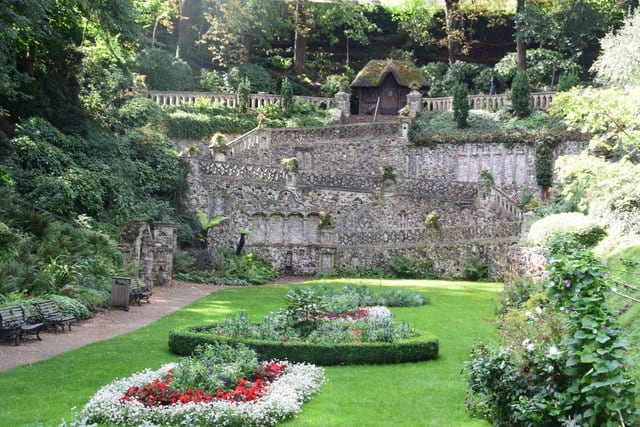
Norwich's Plantation Garden is a place many people recognise for its paths, planting and unusual setting. In a new artwork by Sutapa Biswas, that familiar local landscape becomes part of a story that reaches well beyond the city. Biswas's film Ballad of the Flowers, Chapter 1 was made in the Plantation Garden and is coming to East Gallery at Norwich University of the Arts. Rather than treating the garden simply as a picturesque backdrop, the project uses the botanical world to ask questions about who moves plants, who controls trade and how the histories of places become connected. That is the gallery's description of the work, not a review by somebody who has watched it. The exhibition opens on Friday 6 November 2026 and continues until Saturday 23 January 2027. There is also a preview evening on Thursday 5 November, with separately advertised screening times. Why a garden can carry more than one historyPlants have an everyday place in a city: they grow in gardens, appear in public spaces and shape what people notice as the seasons change. Their histories can also be bound up with movement across countries, commerce and unequal relationships of power. According to the university's exhibition account, Biswas draws on botanical histories and archival material concerning the East India Company's movement of plants and animals from India. The film places those subjects alongside questions of empire, class, gender and migration. |
 Illustration: plants and botanical research materials; not imagery from the film. |
The university describes a mysterious song shared between flowers and a combination of dance, performance, choreography and poetic monologue. It also credits Biswas's own voice as part of the soundtrack. These are details supplied by the exhibition organisers; no claim is being made here about what a visitor will feel or see in a particular sequence. The link to the Plantation Garden gives a Norwich audience an unusually direct point of entry. A landscape people may know from ordinary walks or photographs has become the setting for an artwork with international historical concerns. Recognising the location is one way into the subject, but the work's intended questions extend far beyond recognising a garden. Made with Norwich contributorsThe project also has a local production story. The university says the film was developed through its East Gallery Fellowship and involved staff and students from several disciplines. Their contributions included costume design and construction, movement, choreography, acting and cinematography. It is tempting to turn that list into a scene from a film set, with imagined rehearsals or conversations. The verified record supports something more precise: creative work from different areas of the university formed part of the production. It does not tell us exactly how an individual contributor experienced the collaboration or what each person took away from it. That distinction matters in writing about creative work. The names on the credits and the disciplines involved are part of the story, while personal accounts would require actual conversations with those taking part. A future follow-up could ask the gallery to introduce willing student or staff contributors, but this preview does not invent their testimony. |
 Illustration: fabric and sewing tools; not materials from the film production. |
Biswas has worked for more than four decades across art that examines history, representation and identity, according to the university. It awarded her an honorary professorship in 2026, recognising her work and her engagement with these subjects. The new film sits within that longer practice while remaining tied to a particular Norwich location and local university collaboration. What is being shownThe gallery describes Chapter 1 as a short single-screen film of around 15 minutes. A second chapter is planned for locations connected with the East India Company, but there is no reason to treat that future production as a confirmed visitor event in Norwich. For those interested in how artists develop a work, the subject offers several different ways to approach it. There is the choice of location, the history behind the botanical imagery and the practical collaboration across film, movement and costume. The artwork may bring these together on screen, but its interpretation belongs to each visitor rather than to an advance article pretending to be a review. East Gallery itself is at Cavendish House, 28–32 St Andrews Street, Norwich, NR2 4AE. It is a public gallery run by Norwich University of the Arts, rather than part of the Plantation Garden. The university marks this exhibition as a free event. When to visitThe exhibition is advertised from 6 November 2026 to 23 January 2027. The listed public hours are Tuesday to Friday, noon to 5pm, and Saturday, noon to 4pm. Holiday variations should be checked before making a journey, particularly later in the run. Thursday 5 November's preview is advertised from 5pm to 7pm, with screenings listed for 5pm, 5.30pm, 6pm and 6.30pm. The gallery's visitor information and exhibition page are the appropriate places to confirm current details, including any booking requirement and remaining preview places. What makes the exhibition distinctive for Norwich is not only that the film was shot in a recognisable garden. It is the meeting of a place, a set of historical questions and the work of people across the university. For readers curious about contemporary art, it offers a reason to look at a local landscape from a different angle. |




0 Comments
Join the conversation
Be the first to comment
Share your thoughts above.